
Category: Uncategorized
SAT_Problems091319_3
Willen usually buys 2.5 pounds of deli meat and 1.8 pounds of cheese each week. He makes the same sandwich to take to work each day. Usually he works five days, but this week he only works three days. What is the total weight of meat and cheese Willen should buy this week?
SAT_Problems091319_2
An ice cream cake has 12 ounces of ice cream, 15 ounces of cake and 4.5 ounces of frosting. Yusef cuts the cake into 12 equal slices. What is the weight of each slice?
SAT_Problems091319_1
Usually, Zara makes fruit salad with one pineapple, 8 strawberries, and 2 oranges. This weekend she is hosting a party and plans to make a fruit salad that is four times bigger. How many total fruits should Zara buy?
Math Problems
What’s the tip?
The Art of Color
Color is what we see because of reflected light. Light contains different wavelengths of energy that our eyes and brain “see” as different colors. When light hits an object, we see the colored light that reflects off the object.
Red, blue, and yellow are the primary colors. With paints of just these three colors, artists can mix them to create all the other colors. When artists mix pigments of the primary colors, they make secondary colors.
Red + Blue = Purple
Red + Yellow = Orange
Blue + Yellow = Green
Did you know that your computer screen also works by using three primary colors? But here, since the colors are light from the monitor and not paints, the three primaries are not the same. Instead, your computer screen mixes other colors from red, blue, and green.
One important thing painters know: using complementary colors—the ones across from each other on the color wheel (red-green, blue-orange, and yellow-purple)—make both colors seem brighter and more intense. They seem to vibrate and pop out at you, the viewer.
Warm colors—reds, yellows, oranges, and red-violets—are those of fire and the sun. They appear to project. Cool colors—blues, blue-greens, and blue-violets—are those of ice and the ocean. They appear to recede.
Claude Monet
French artist Claude Monet liked to paint the same subject over and over again, at different times of day and in different types of weather. He painted Rouen cathedral in France some thirty times, but what fascinated him most was not the building—it was, he said, the surrounding atmosphere. Rather than quick studies of changing light effects, these pictures, slowly reworked in the studio, are carefully considered explorations of color and mood:
- Each painting uses Rouen Cathedral to record time (morning or late afternoon) and weather (sunlight or mist). Examine the way Monet used color and texture: Can you tell from the shadows in the doorways which painting might have been done in the morning and which in the afternoon? (Don’t forget that the sun rises in the east and these paintings show the west façade or front of the building.) How do the colors change in sunlight, fog, and mist?
- Do you see any clear outlines? Is it possible to determine exactly where one surface ends and another begins? If line does not define the forms in this painting, what does?
Matisse
Around 1905 several artists, including Matisse, exhibited pictures in which heightened color was used to express a strong emotional response to nature. The painters were called “fauves,” or wild beasts. The freshness and strength of the tones in Open Window, Collioure are typical of the fauves; Matisse’s contrasts are subtle, giving this work a sense of serenity and radiance. Show students this painting (second to last image in the slideshow) to answer the following questions:
- Would you rather go sailing or stay in your cool room admiring the view?
- Describe the colors. How are they different from what you see in nature? What color would you usually use to color the ocean? Have you ever seen a pink sea? (Perhaps if it’s reflecting a sunset…)
- How big do you think this painting is? It’s actually only 21 3/4 x 18 1/8 inches. See how Matisse transformed the effect of a small canvas into expansive pictorial space through the device of the open window and eye-popping color.
Activity
Monet painted this photograph of the west façade of Rouen Cathedral in Paris. He painted this shape at different times of day and all types of weather. Students will select a time of day and type of weather and then color over this faded image using appropriate hues in oil pastel (preferable to cover image, but crayons could also be used).
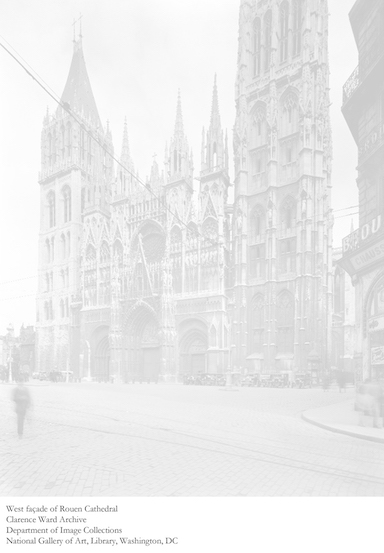
- What colors show sunrises?
- What colors show fall?
- What colors show snowfall?
Use one or more photographs to explore how the same shape can show different colors at different times.
Greta Thunberg Speech to the UN
My name is Greta Thunberg. I am 15 years old.
I am from Sweden. I speak on behalf of Climate Justice Now.
Many people say that Sweden is just a small country and it doesn’t matter what we do. But I’ve learned you are never too small to make a difference.
And if a few children can get headlines all over the world just by not going to school, then imagine what we could all do together if we really wanted to. But to do that, we have to speak clearly, no matter how uncomfortable that may be.
You only speak of green eternal economic growth because you are too scared of being unpopular. You only talk about moving forward with the same bad ideas that got us into this mess, even when the only sensible thing to do is pull the emergency brake.
You are not mature enough to tell it like is. Even that burden you leave to us children.
But I don’t care about being popular. I care about climate justice and the living planet.
Our civilization is being sacrificed for the opportunity of a very small number of people to continue making enormous amounts of money.
Our biosphere is being sacrificed so that rich people in countries like mine can live in luxury. It is the sufferings of the many which pay for the luxuries of the few.
The year 2078, I will celebrate my 75th birthday. If I have children maybe they will spend that day with me. Maybe they will ask me about you. Maybe they will ask why you didn’t do anything while there still was time to act.
You say you love your children above all else, and yet you are stealing their future in front of their very eyes.
Until you start focusing on what needs to be done rather than what is politically possible, there is no hope. We cannot solve a crisis without treating it as a crisis.
We need to keep the fossil fuels in the ground, and we need to focus on equity. And if solutions within the system are so impossible to find, maybe we should change the system itself.
We have not come here to beg world leaders to care. You have ignored us in the past and you will ignore us again.
We have run out of excuses and we are running out of time.
We have come here to let you know that change is coming, whether you like it or not. The real power belongs to the people. Thank you.
I am from Sweden. I speak on behalf of Climate Justice Now.
Many people say that Sweden is just a small country and it doesn’t matter what we do. But I’ve learned you are never too small to make a difference.
And if a few children can get headlines all over the world just by not going to school, then imagine what we could all do together if we really wanted to. But to do that, we have to speak clearly, no matter how uncomfortable that may be.
You only speak of green eternal economic growth because you are too scared of being unpopular. You only talk about moving forward with the same bad ideas that got us into this mess, even when the only sensible thing to do is pull the emergency brake.
You are not mature enough to tell it like is. Even that burden you leave to us children.
But I don’t care about being popular. I care about climate justice and the living planet.
Our civilization is being sacrificed for the opportunity of a very small number of people to continue making enormous amounts of money.
Our biosphere is being sacrificed so that rich people in countries like mine can live in luxury. It is the sufferings of the many which pay for the luxuries of the few.
The year 2078, I will celebrate my 75th birthday. If I have children maybe they will spend that day with me. Maybe they will ask me about you. Maybe they will ask why you didn’t do anything while there still was time to act.
You say you love your children above all else, and yet you are stealing their future in front of their very eyes.
Until you start focusing on what needs to be done rather than what is politically possible, there is no hope. We cannot solve a crisis without treating it as a crisis.
We need to keep the fossil fuels in the ground, and we need to focus on equity. And if solutions within the system are so impossible to find, maybe we should change the system itself.
We have not come here to beg world leaders to care. You have ignored us in the past and you will ignore us again.
We have run out of excuses and we are running out of time.
We have come here to let you know that change is coming, whether you like it or not. The real power belongs to the people. Thank you.
Finalizing your paper for your audience
Every piece of writing has an audience. We mostly write for teachers, sometimes we write for college admissions officers, and we always write to make ourselves proud of our effort.
Before you submit a paper, be sure the organization, word choice and formatting matches your audience’s expectations.
If you want help with your final reviews, you can upload your draft here.
|
Upload your final draft here.
|
|
|
|
|
|
|
You can return to the Writing Process page or your edMe homepage.
Working with your first draft
First drafts give you the opportunity to tell your story. It shows the flow of your ideas and gives you the chance to turn good into great.
We are happy to help you review your draft. It is important to review first drafts in two ways:
- Make sure your ideas flow. Your whole paper should be organized to make your point. Each paragraph should be organized so your introduction is supported by the body of your paragraph.
- Clean up the grammar. It’s annoying but important to make sure your paper is error free. If you have errors, your readers will be thinking about your errors and not your brilliant ideas!
If you want help with your draft, upload it here.
|
Upload your first draft here.
|
|
|
|
|
|
|
You can return to the Writing Process page or your edMe homepage.
Working on your writing plan
Think about what type of writing you are doing (explaining a topic, arguing a point, telling a story, proposing an idea). Your writing will always have a theme or main idea. Start with your main idea then start writing down the supporting ideas and details you want to include.
Write these ideas out in any way that makes sense to you. This brainstorming idea is the beginning of an excellent paper.
If you are looking for feedback, you can upload your initial graphic organizer here.
|
Upload your writing plan here.
|
|
|
|
|
|
|
You can return to the Writing Process page or your edMe homepage.